

Warehouse slotting and location strategy is the practice of deciding which SKUs sit in which warehouse locations, based on how often they move, how they're packed, and how they get picked, so that travel time and picking errors both go down. Shipider tracks every item at the location and pallet level, so slotting decisions actually stick instead of drifting back into whatever's closest to the door.
Most small warehouses never sit down and design a slotting plan. Inventory ends up wherever there was space the day it arrived, and six months later nobody remembers why the best-selling SKU is in the back corner while a slow mover sits at the pack station. This isn't a failure of the team. It's what happens when location decisions are made one pallet at a time with no system tracking the pattern.
What warehouse slotting actually means
Slotting is the assignment of specific warehouse locations to specific SKUs (or SKU groups) based on demand, size, weight, and handling needs. A location strategy is the broader set of rules that governs how those assignments get made and updated over time: which zones exist, how aisles are numbered, how pallet locations relate to pick locations, and how often the layout gets reviewed.
Done well, slotting shortens pick paths, reduces the chance a picker grabs the wrong SKU from an adjacent bin, and makes cycle counts faster because similar items aren't scattered across the building. Done poorly (or not at all), it quietly adds minutes to every pick and creates the exact conditions that cause SKU discrepancies to pile up.
Why small warehouses skip slotting and pay for it
Slotting sounds like an enterprise problem, something for a 200,000 square foot distribution center with a full engineering team. That's part of why small warehouses skip it. But the underlying issue, wasted travel time and pick errors from disorganized locations, hits small operations just as hard, sometimes harder, because there's no buffer of extra staff to absorb the inefficiency.
The other reason slotting gets skipped is tooling. If your location data lives in a spreadsheet or in people's memory, redesigning your layout means a whiteboard session that nobody has time to run twice a year. A location strategy only stays useful if it's easy to see, easy to update, and tied to the actual movement data, not a one-time diagram that gets stale the week after receiving brings in new stock.
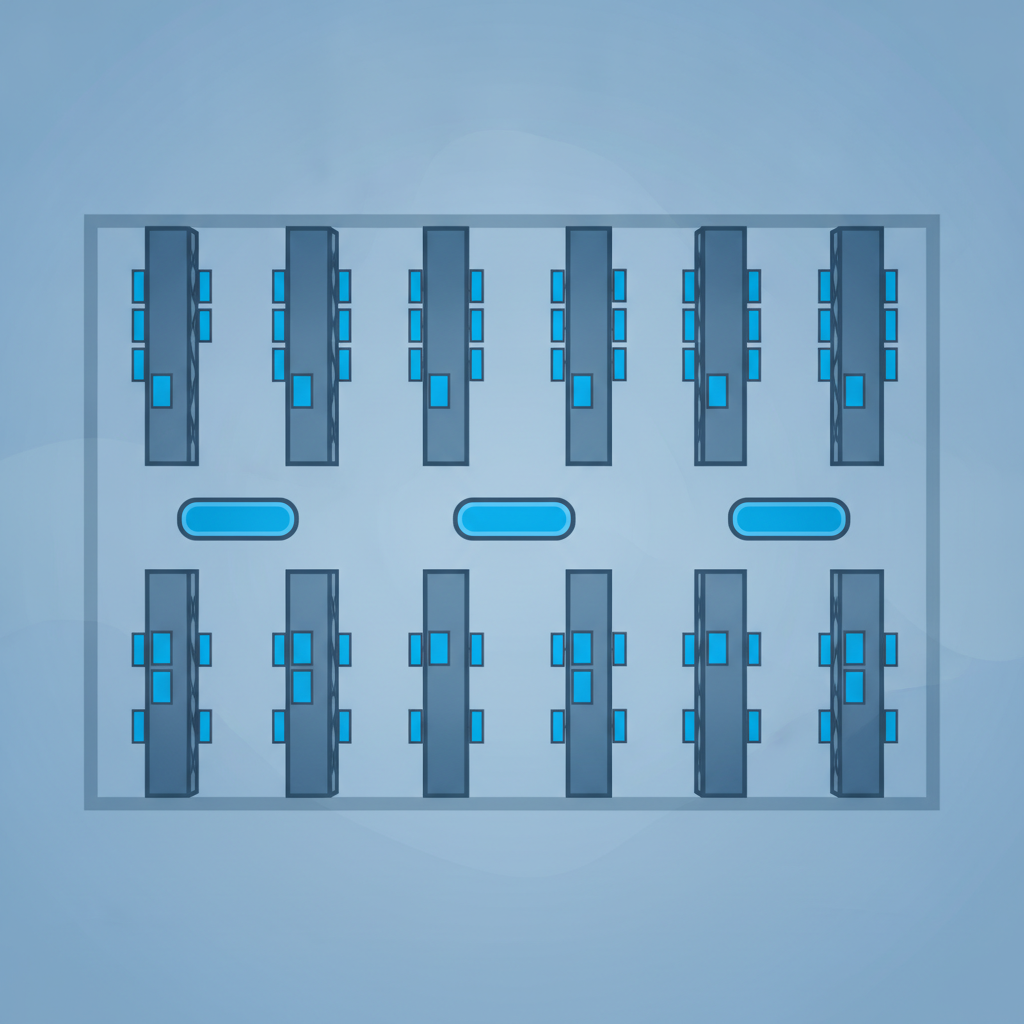
Core slotting strategies compared
There are a handful of standard approaches. Most small warehouses end up blending two of them rather than picking one purely.
| Strategy | How it works | Best fit | Watch out for |
|---|---|---|---|
| Fixed slotting | Every SKU has one permanent home location | Stable catalogs with predictable demand | Wastes space when a SKU's volume drops but the slot stays reserved |
| Random / dynamic slotting | SKUs go wherever there's open space, tracked by system | High SKU counts, fast-moving catalogs, 3PLs | Requires reliable location tracking or pickers get lost |
| Velocity-based (ABC) slotting | Fast movers (A) near pack stations, slow movers (C) further back | Warehouses with clear best-sellers and long tails | Needs periodic re-ranking as seasonality shifts what's "fast" |
| Family / affinity grouping | SKUs commonly ordered together are placed near each other | Kitted or bundled orders, B2B distributors | Requires order history analysis, not just unit velocity |
Fixed slotting
Fixed slotting is the simplest to explain and the easiest for new staff to learn: SKU 4021 always lives in A-12-3. It works well when your catalog doesn't change much and demand is steady. The downside shows up when a product line gets discontinued or seasonality kicks in: the slot sits underused while other items are crammed into overflow.
Random or dynamic slotting
In dynamic slotting, items go into whatever open location makes sense at the time, and the system (not a person's memory) tracks exactly where each pallet or SKU landed. This is common in 3PL environments where SKU count and client mix change constantly. It only works if location lookups are fast and accurate, which is why pairing it with barcode scanning at the point of putaway matters more here than in a fixed system.
Velocity-based (ABC) slotting
This is the classic approach: rank SKUs by pick frequency, put the A items (roughly the top 20 percent that account for most of your volume) closest to packing, B items in the middle zones, and C items further out. It's the highest-leverage change most small warehouses can make, because it directly shortens the average pick path without touching headcount or hardware.
Family or affinity grouping
Some warehouses get more value from grouping SKUs that are frequently ordered together, regardless of individual velocity. A distributor shipping bundled hardware kits, for example, benefits more from having the kit components in the same aisle than from strict A/B/C ranking. This requires looking at order history, not just unit movement, to spot which SKUs travel together.
Building a location strategy without a full overhaul
You don't need to shut the floor down for a week to fix your slotting. A practical sequence looks like this:
1. Pull your actual movement data
Before moving anything, look at which SKUs actually get picked most often over the last 60 to 90 days. Gut feel about "our best sellers" is frequently wrong once you check the numbers, especially for warehouses handling multiple brands or clients.
2. Map current locations against that data
Overlay the velocity ranking on your existing floor plan. You're looking for the obvious mismatches first: A-tier items in the farthest bins, C-tier items sitting right next to the pack station.
3. Move the highest-impact SKUs first
You don't need to re-slot the whole warehouse in one pass. Moving your top 10 to 20 SKUs into better locations usually captures most of the available time savings, with far less disruption than a full reset.
4. Record the new location in the system, not on a sticky note
This is the step that determines whether the improvement lasts. If the new home for a SKU only exists in one supervisor's head, it reverts within a month. Location changes need to be logged somewhere every picker's scan can confirm.
5. Review on a schedule, not just when things feel wrong
Slotting isn't a one-time project. A quarterly review, tied to actual velocity data, catches drift before it costs you a season's worth of extra travel time.
Signs your slotting strategy needs a reset
A few patterns are reliable warning signs. Pickers consistently walk past several aisles to reach your top sellers. New hires take unusually long to learn the floor because there's no logical pattern to explain, just memorized exceptions. Cycle counts take longer than they should because similar SKUs are scattered rather than grouped. And when you check your inventory accuracy KPIs, discrepancies cluster around specific zones rather than being evenly distributed, often a sign that a crowded or poorly labeled location is causing pickers to grab the wrong bin.
How Shipider supports slotting without new hardware
Shipider tracks every SKU and pallet down to the exact warehouse location, and that location data updates in real time as items move through receiving and putaway. That matters for slotting in a few concrete ways.
First, because every putaway and pick is confirmed with in-browser camera barcode scanning on any phone, there's no gap between where a system thinks a SKU is and where it actually is. Dynamic or velocity-based slotting depends entirely on that kind of accuracy; without it, a re-slot just creates new confusion.
Second, the maker-checker verification on order processing means a second scan confirms the pick before it ships, which catches the moments right after a re-slot when staff are still adjusting to new locations and most likely to grab from muscle memory instead of the current bin.
Third, for 3PLs managing multiple clients under one roof, Shipider's multi-tenant isolation and multi-site inventory tracking mean each client's slotting rules and locations stay separate, even when they share a physical building. A small warehouse running its own single site gets the same location-level tracking without needing the multi-tenant layer at all, since setup scales to what you actually run.
None of this requires new scanners, fixed installations, or a multi-month rollout. If you're planning a re-slot, it's worth reading the broader picture in our warehouse operations library, and pairing slotting changes with a look at your current picking strategy, since the two decisions reinforce each other.
Frequently asked questions
What is warehouse slotting?
Warehouse slotting is the process of assigning specific storage and pick locations to specific SKUs based on factors like pick frequency, size, weight, and how items are typically ordered together, with the goal of shortening travel time and reducing pick errors.
How often should a small warehouse re-slot?
Most small warehouses benefit from a full velocity review every quarter, with smaller adjustments made anytime a SKU's demand shifts noticeably, such as after a promotion, a seasonal spike, or a new product launch.
Does slotting require a full WMS or special hardware?
No. Slotting decisions can be made from movement data alone, and tracking the resulting locations only requires a system that records where each SKU actually sits, which Shipider handles through in-browser barcode scanning on any phone without dedicated scanner hardware.
What's the difference between slotting and a location strategy?
Slotting is the specific assignment of SKUs to locations, while a location strategy is the broader set of rules, such as zone layout, aisle numbering, and review cadence, that governs how those assignments get made and kept current over time.
Which slotting method is best for a small warehouse just starting out?
Velocity-based (ABC) slotting usually delivers the most improvement for the least disruption, since moving only your top-selling SKUs closer to the pack station captures most of the time savings without requiring a full floor redesign.
If your locations are still tracked in a spreadsheet or a memorized layout, start with Shipider and get every SKU, pallet, and location on one real audit trail.
Related reading: Reorder Points and Safety Stock Basics for Small Warehouses
Related reading: Peak Season Warehouse Prep Checklist: What to Fix Before Volume Spikes