
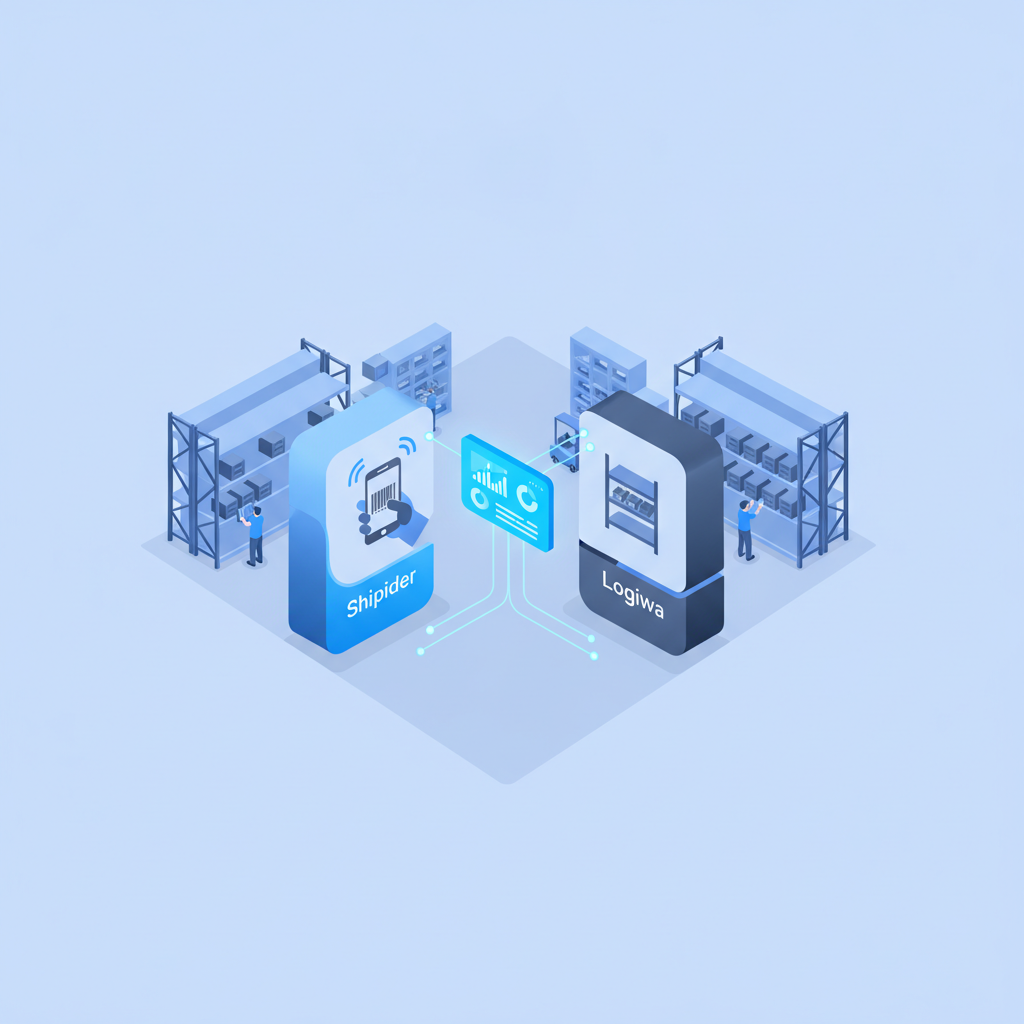
Shipider and Logiwa are both warehouse management systems, but they are built for different stages of growth. Shipider is a multi-tenant WMS designed for SMB 3PLs, ecommerce brands, and small-to-mid warehouses that need maker-checker order confirmation, in-browser barcode scanning, and pallet-level traceability without buying hardware, with a free plan and published usage-based pricing. Logiwa positions itself for "Growth-focused 3PLs", "high-volume brands", and B2C/DTC fulfillment, with custom pricing set during a consultation. If your team is scanning with phones, wants to see a price before a sales call, and runs a smaller floor, the right-size question matters more than a feature checklist.
Last verified: November 2026. Competitor details come from each vendor's public pricing and product pages; check them before you buy, and tell us if something has changed.
This comparison is written for teams that have already shortlisted Logiwa and want to know whether a lighter, no-hardware alternative actually covers their floor. We are not claiming Shipider matches Logiwa at high volume. We are laying out where each one is the better fit, and where the gap between "built for scale" and "fast to start" actually shows up.
Shipider vs Logiwa at a glance
The table below covers the dimensions that usually decide this choice: pricing, setup, scanning, verification, and who each platform is built for. Logiwa details come from its own website, checked in November 2026.
| Dimension | Shipider | Logiwa |
|---|---|---|
| Primary fit | SMB 3PLs, ecommerce brands, small-to-mid warehouses | "Growth-focused 3PLs", "high-volume brands", B2C/DTC |
| Barcode scanning | Camera-based scanning in any phone browser, no app or dedicated hardware | Android app (APK) and iOS app; no fixed device list published |
| Verification model | Built-in maker-checker: one person processes an order, a second confirms it | Two-person check not found on their site |
| Multi-client 3PL | Tenant isolation; SKUs and orders tied to customer records; no client portal | "Complete Multi-Client 3PL Management" with client portal |
| Pricing model | Published token-based pricing, free plan, no per-seat fees | Custom plan set "during a brief consultation", based on "fulfillment volume and complexity, not your user count" |
| Users | Unlimited, free | Unlimited |
| Free trial or plan | Free plan | Not published (checked Nov 2026) |
| Onboarding | Self-serve with Excel import templates; no onboarding invoice | Included; marketing says "onboard operations in days" (no stated timeline) |
| Multi-site inventory | Multiple warehouses in one account, with transfers between them | Yes |
Where Logiwa fits best
Logiwa tends to come up in conversations with operations that have already scaled past the point where a lightweight system covers their needs: high order volume across several channels, many clients who expect their own portal, and fulfillment complexity that justifies a consultative plan. If that describes you, that is a legitimate use case and outside the scope of what this article is trying to settle. We are not going to pretend Shipider replaces a platform built for that scale, because it is not trying to.
The honest signal to watch for: if your evaluation already involves a multi-stage sales cycle, a solutions engineer, and a custom plan built around your volume, you are probably in Logiwa's intended range, not Shipider's.
Where Shipider fits best
Shipider is built for the operation that outgrew spreadsheets but is not ready for an enterprise rollout. That usually looks like a small 3PL with a handful of client accounts, a DTC brand running its own fulfillment out of one or two sites, or a B2B distributor that needs pallet-level traceability without a long implementation. The core of the pitch is simple: pick up a phone, scan a barcode in the browser, and have every order confirmed by a second person before it is closed out. No scanner guns to provision, no device fleet to manage, no license seats to true up every renewal.
Multi-tenant isolation is built in, not a configuration toggle. Each company's data is isolated at the tenant level, and inside your account every SKU, pallet, and order is tied to a customer record, which is the detail that usually decides whether a 3PL trusts a system with multiple clients' stock in one building. For a deeper look at this fit, see our Logiwa alternative breakdown for SMB and small-warehouse teams, which covers the same ground from the other direction.
Setup and onboarding time
One of the clearest differentiators between a system built for SMB teams and one built for high-volume fulfillment is how you get started. Shipider is self-serve: you sign up on the free plan, import your location map, pallet locations, and order SKUs from Excel templates, and start scanning receipts and put-aways. There is no hardware procurement step because the scanning happens in the browser on phones your team already carries, and there is no onboarding invoice.
Logiwa includes onboarding in its plans and its marketing says you can "onboard operations in days", but it does not publish a specific timeline, and you reach onboarding after a consultation sets your custom plan. Ask for the expected go-live date in writing during that call. For more on how to evaluate this trade-off directly, read our guide to WMS implementation timelines.
Hardware requirements
Shipider's scanning runs entirely in the browser using the camera on any phone, iOS or Android, with no app installation and no dedicated device fleet. That removes a real line item from a small warehouse's budget and a real failure point from the floor (lost scanners, dead batteries, broken screens, device replacement cycles). Many WMS rollouts assume dedicated scanners at $500 to $5,000 per station.
Logiwa runs through native apps: an Android app distributed as an APK and an iOS app, without a fixed device list on its site. That is flexible, but it means installing and updating an app on each device. Dedicated hardware can also outperform a phone camera on raw scan speed for very high scan counts per station; if your operation runs at that rate, the trade-off may favor dedicated scanners whatever WMS you choose. If you are running a few hundred scans a shift, the phone-in-browser model usually wins on total cost and flexibility. We cover this trade-off in more detail in phone camera scanning vs bluetooth gun vs rugged handheld.
When hardware-free scanning is the better call
If your warehouse has a handful of stations, seasonal staffing swings, or multiple small sites that each need scanning coverage without a capital outlay, browser-based scanning removes the procurement and maintenance overhead entirely. Workers scan with the phones they already have, and new seasonal hires are productive without a device handoff process.
Pricing model
Shipider uses token-based, usage-driven pricing with a free plan. Setup, users, and integrations are free, and viewing inventory and reports is always free, so you pay based on actual platform activity, which tends to track closely with real operational volume for SMB teams with variable headcount. Full current pricing is on the Shipider pricing page.
Logiwa is not per-seat either: it says pricing is based on "fulfillment volume and complexity, not your user count", with unlimited users. The difference is visibility. Logiwa determines "a custom plan during a brief consultation", so you will not know the number until after a sales conversation, while Shipider's rates are published and you can start free. For the broader argument on why pricing shape matters, see usage-based vs per-seat WMS pricing and hidden costs of WMS software.
Multi-tenant and 3PL fit
For 3PLs specifically, the question is not just "can this system track inventory for multiple customers," it is "how are clients kept apart, and what do they see." Shipider isolates each company's data at the tenant level and ties every SKU, pallet, and order to a customer record, which simplifies onboarding a new client without reworking your data model each time. Combined with maker-checker confirmation, a 3PL gets a defensible record of who received, processed, and confirmed what, on behalf of which customer. Shipider does not include a client portal or client invoicing; per-client data can be exported or pulled via the API. See Shipider for 3PLs for the full picture, or how to onboard a new 3PL client without adding headcount for the operational detail.
Logiwa advertises "Complete Multi-Client 3PL Management" with a client portal. If your clients need to log in and check their own stock, that is a point in Logiwa's favor.
Audit trail and verification
In Shipider, orders move from Pending to Approved to Processing to Processed, and a second person must confirm them before they reach Confirmed. The record shows who processed and who confirmed each order, and pallets carry location history, photos, and moves attributed to users. The maker-checker model catches mis-picks and mis-ships before they leave the building rather than after a customer complains. It is part of the core order flow, not an add-on module. For the mechanics, read what is a maker-checker workflow. We did not find a comparable two-person check described on Logiwa's site.
Which one should you choose
Choose Logiwa if your operation already runs at a volume and complexity where a consultative, custom-priced plan is justified by scale, your clients expect a portal, and your team has the bandwidth for that buying process.
Choose Shipider if you are an SMB 3PL, an ecommerce brand running your own fulfillment, or a small-to-mid warehouse that needs maker-checker accuracy, pallet-level traceability, and multi-site inventory visibility, and you want to start free using phones you already own, paying for what you actually use. For the full evaluation framework across every alternative, see how to compare and evaluate WMS alternatives, or check fit directly against Shipider for small warehouses or Shipider for ecommerce.
Frequently asked questions
Is Shipider a direct replacement for Logiwa?
Not at every scale. Shipider is built for SMB 3PLs, ecommerce brands, and small-to-mid warehouses that need fast setup and no hardware. For high-volume, multi-channel fulfillment or 3PLs whose clients need a portal, Logiwa may be the better fit. Evaluate based on your actual transaction volume and complexity, not brand name alone.
Does Shipider require barcode scanner hardware or an app like Logiwa?
No. Shipider scans barcodes using the camera built into any phone, directly in the browser, with no app install and no dedicated scanner hardware required. Logiwa uses Android and iOS apps and does not publish a fixed device list.
How is Shipider's pricing different from Logiwa's?
Both avoid per-seat pricing. Shipider publishes token-based rates and has a free plan, so you can see the cost before talking to anyone. Logiwa sets a custom plan during a consultation based on fulfillment volume and complexity, with unlimited users. Full Shipider details are on the pricing page.
Can a 3PL run multiple customers on Shipider the way it might on Logiwa?
Yes. Shipider isolates each company's data and ties every SKU, pallet, and order to a customer record, and pairs that with maker-checker confirmation so each customer's orders have a defensible record. Logiwa adds a client portal, which Shipider does not have.
How long does it take to go live on Shipider compared to Logiwa?
Shipider setup is self-serve, using Excel import templates for locations, pallet locations, and order SKUs, with no hardware procurement step and no consultation required. Logiwa includes onboarding and markets going live "in days", but does not publish a specific timeline.
If you are ready to see whether Shipider fits your floor without a sales cycle, create your account and import your first warehouse today.
Related reading: Shipider vs Sortly: When You Have Outgrown an Inventory-Only Tracker
Related reading: What Is a WMS? A Plain-Language Definition for Teams Leaving Excel
Related reading: Building an ROI Business Case for a WMS: What to Show Your Leadership