

A WMS RFP template is a structured document that procurement teams send to warehouse management system vendors, including Shipider, to collect comparable answers on functionality, pricing, security, and implementation before a final buying decision. Paired with a weighted vendor scorecard, it turns vendor demos and sales calls into a side-by-side comparison that your team, finance, and operations leaders can all sign off on.
Most procurement teams already have a general sense of what they want from a WMS. The hard part is getting three or four vendors to answer the same questions in the same format, so you can compare apples to apples instead of comparing a glossy deck from one vendor to a spreadsheet from another. That is what an RFP template and scorecard are for: forcing structure onto a process that otherwise drifts toward whoever presented best last.
Why an RFP template is different from a checklist or a demo script
If you have already read a WMS buying checklist, you have the criteria: traceability, multi-site support, maker-checker controls, integration depth, and so on. If you have used a list of vendor demo questions, you have a script for live calls. An RFP template is the document that formalizes both into something vendors respond to in writing, on the record, before you sign anything.
This matters for procurement specifically. A checklist lives in your head or a shared doc. Demo questions get answered verbally and are easy to forget or misremember three weeks later. An RFP response is written, dated, and attributable to a specific vendor rep, which gives you something to point back to if a feature promised in sales turns out to be a future roadmap item once you are live.
What to include in a WMS RFP template
A usable RFP does not need to run forty pages. It needs enough structure that every vendor answers the same questions in the same order. Here is a section-by-section outline that covers the ground procurement teams actually need.
1. Company and project overview
State your current state (spreadsheets, legacy WMS, or an ERP warehouse module), your order volume, SKU count, number of sites, and whether you run single-tenant operations or a 3PL serving multiple clients under one roof. Vendors answer more precisely when they know whether they are quoting a single e-commerce brand or a multi-tenant 3PL.
2. Functional requirements
This is the core of the document. Ask vendors to confirm, in writing, whether they support: receiving against purchase orders, putaway to named warehouse locations, pallet and SKU-level tracking, a two-step verification step before orders ship (maker-checker), barcode scanning without dedicated hardware, and multi-site inventory visibility from one account. Ask them to state clearly what they do not support rather than let silence imply a yes.
3. Technical and integration requirements
Cover API availability, webhook support, Excel or CSV import for initial data load, and how ERP or storefront sync is handled. Ask specifically whether integrations require custom development work or professional services hours, since that line item is where hidden costs tend to hide.
4. Security, audit, and compliance
Ask for details on audit trail depth (does every inventory movement get logged with a user and timestamp, or only some actions), data isolation between tenants if you run multiple clients, and any compliance certifications relevant to your industry.
5. Pricing and commercial terms
Ask for pricing structure (per seat, per user, or usage-based), what counts as a billable unit, whether there are implementation fees, and what the contract minimum term looks like. This section is where usage-based versus per-seat pricing differences become concrete numbers instead of abstract models.
6. Implementation and support
Ask for a realistic go-live timeline, what data migration support is included, and what ongoing support looks like after launch (ticket-based, dedicated rep, community forum). Vague answers here ("it depends on scope") are a signal worth following up on directly.
The vendor scorecard: scoring responses consistently
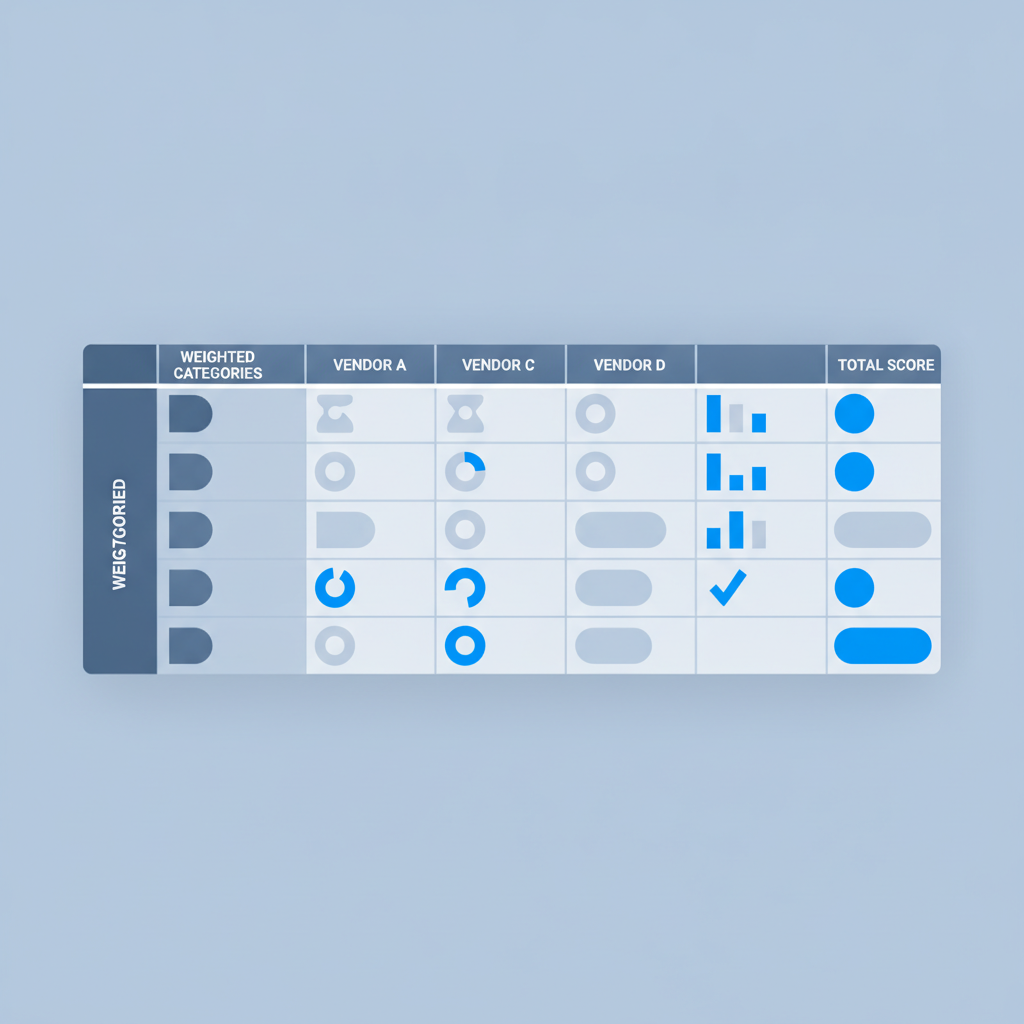
Once RFP responses come back, score them against the same weighted criteria rather than ranking vendors on gut feel. A simple 1 to 5 scale per category, multiplied by a weight reflecting how much that category matters to your operation, produces a comparable total score across vendors.
| Category | Suggested weight | What a 5 looks like | What a 1 looks like |
|---|---|---|---|
| Functional fit (receiving, putaway, picking, dispatch) | 25% | Covers your full workflow natively, no workarounds | Missing core steps, requires manual tracking outside the system |
| Traceability and audit trail | 20% | Full movement history with user, timestamp, and pallet or SKU detail | Limited or no history beyond current stock levels |
| Verification controls (maker-checker) | 15% | Built-in second-check step before orders dispatch | No verification step, relies on operator discipline alone |
| Integrations and API | 15% | Documented API, webhooks, and import tools with no custom dev required | Integration requires professional services for basic connections |
| Pricing transparency | 10% | Clear usage-based or token pricing, no hidden per-seat surprises | Pricing depends on a quote with unclear inclusions |
| Implementation speed | 10% | Live in days to weeks with self-serve setup | Multi-month rollout with mandatory professional services |
| Multi-site or multi-tenant support | 5% | Native support for multiple locations or isolated client accounts | Single-location only, no isolation model |
Multiply each vendor's score per category by the weight, sum the totals, and you have a defensible ranking you can show to finance or leadership without relying on "the demo felt good."
Sample RFP questions by category
Use these as starting points and adjust the wording to your operation. The goal is specificity: a vendor should not be able to answer "yes" without explaining how.
| Category | Sample question |
|---|---|
| Traceability | Describe how your system records pallet-level movement history, including whether photos or signatures can be attached to a receiving or dispatch event. |
| Verification | Does your system require a second user to confirm an order before it ships, and is that step optional or enforced? |
| Scanning | Can warehouse staff scan barcodes using a phone camera in a browser, or does your system require dedicated scanner hardware? |
| Multi-tenant isolation | If we operate as a 3PL, how is data isolated between client accounts, and can a single staff login accidentally see another client's inventory? |
| Pricing | What is the billing unit (seat, order, token, or transaction), and what happens to cost if our order volume doubles next quarter? |
| Implementation | What is your typical time from signed contract to first live order, and what does your team need from us to hit that timeline? |
Common mistakes procurement teams make with WMS RFPs
The most common error is sending an RFP that is really a feature checklist with yes/no boxes. Vendors check "yes" to almost everything because the format rewards it. Ask for short written explanations instead of checkboxes, and you will see real differences surface.
The second mistake is weighting price too heavily before functional fit is settled. A cheaper system that cannot track pallets, enforce a verification step, or handle multiple sites will cost more in rework and mis-ships than it saves in licensing. Weight functional and traceability categories first, then compare pricing among vendors that already clear the functional bar.
The third mistake is skipping a reference check or pilot entirely because the RFP looked complete on paper. Written answers are a filter, not a substitute for seeing the system handle your actual SKUs and order volume.
Where Shipider fits in an RFP process
Shipider covers the categories most RFPs ask about directly: receiving against purchase orders, putaway to named warehouse locations, pallet and SKU tracking, a built-in maker-checker verification step before orders dispatch, in-browser barcode scanning on any phone with no scanner hardware to buy, multi-site inventory for teams running more than one location, and structural multi-tenant isolation for 3PLs managing multiple customers under one roof. Every inventory movement is logged on a real audit trail, which answers the traceability section of most RFPs without a workaround. Pricing is token-based rather than per-seat, which tends to simplify the pricing section of a scorecard since the billing unit scales with activity rather than headcount. You can see current plans on the pricing page, and if you are evaluating specifically for a multi-tenant 3PL operation, the 3PL solutions page covers the isolation and billing model in more depth.
For a broader view of the full buying process, from criteria to demo to final decision, see the WMS buying guide hub.
Frequently asked questions
What should a WMS RFP template include at minimum?
At minimum, include a project overview, functional requirements covering receiving through dispatch, integration and API requirements, security and audit trail questions, pricing structure, and implementation timeline. Each section should ask for written explanations rather than yes/no answers.
How is a vendor scorecard different from an RFP?
The RFP is the document you send to vendors to collect answers. The scorecard is the internal tool you use afterward to score and weight those answers consistently across vendors, so the comparison is numeric rather than based on impressions.
How many vendors should a procurement team include in a WMS RFP?
Three to four vendors is usually enough to get real comparison without making the review process unmanageable. Fewer than three risks missing a better fit; more than five slows down decision-making without adding much new information.
Should pricing or functional fit be weighted more heavily?
Functional fit and traceability should generally carry more weight than pricing, since a system that cannot handle your core workflow will cost more in manual workarounds than it saves in license fees. Compare pricing primarily among vendors that already clear the functional bar.
Can an RFP replace a live vendor demo?
No. An RFP is useful for narrowing the field and getting written commitments, but a live demo or short pilot with your own SKUs and order volume is still the best way to confirm a vendor's written answers hold up in practice.
Ready to see how Shipider answers these questions directly instead of in a PDF? Create a free account and run your own data through it before you finalize your scorecard.