
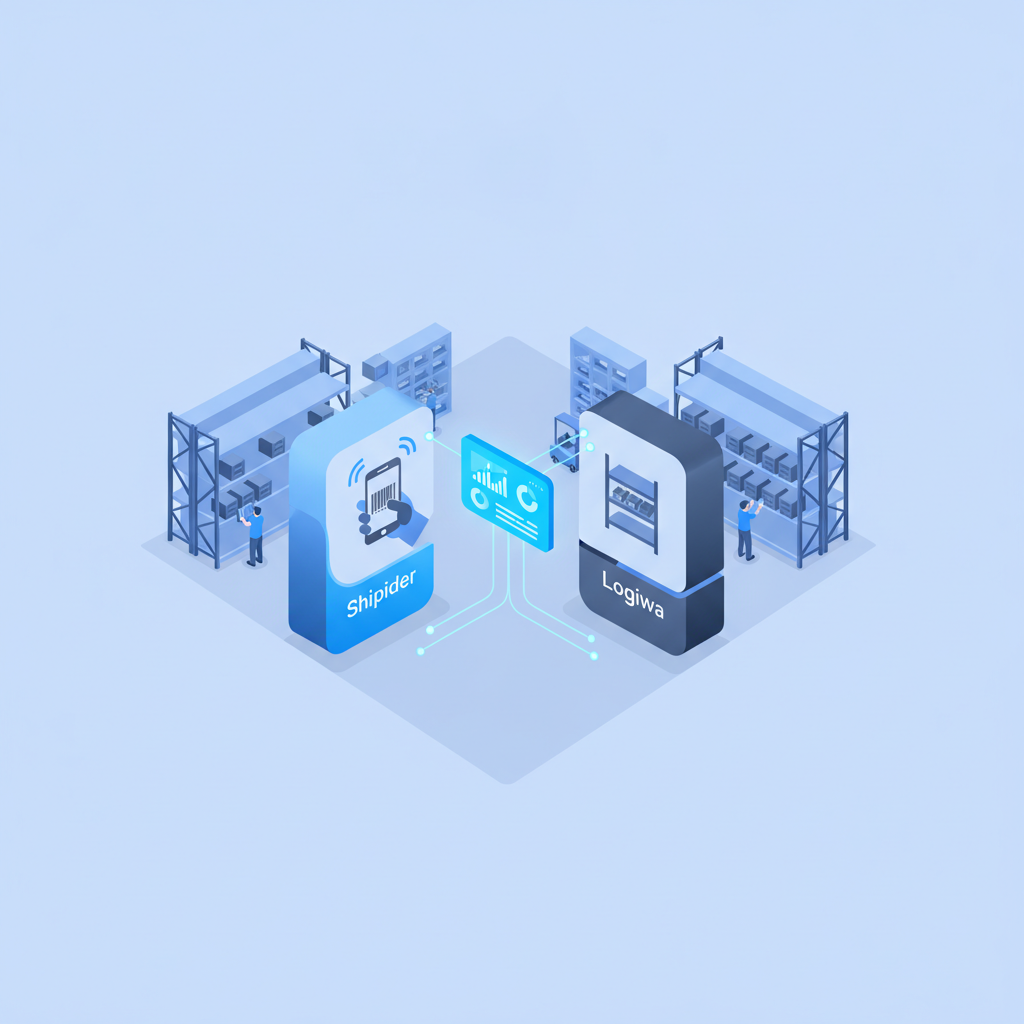
Shipider and Logiwa are both warehouse management systems, but they are built for different stages of growth. Shipider is a multi-tenant WMS designed for SMB 3PLs, ecommerce brands, and small-to-mid warehouses that need maker-checker verification, in-browser barcode scanning, and pallet-level traceability without buying hardware or running a long rollout. Logiwa is generally positioned toward higher-volume, higher-complexity fulfillment operations with more configuration surface area. If your team is scanning with phones, onboarding in days instead of months, and running under a few dozen active users per site, the right-size question matters more than a feature checklist.
This comparison is written for teams that have already shortlisted Logiwa and want to know whether a lighter, no-hardware alternative actually covers their floor. We are not claiming Shipider matches Logiwa at extreme scale. We are laying out where each one is the better fit, and where the gap between "enterprise-capable" and "fast to run" actually shows up.
Shipider vs Logiwa at a glance
The table below covers the dimensions that usually decide this choice: setup time, hardware, pricing shape, and who each platform is built for.
| Dimension | Shipider | Logiwa |
|---|---|---|
| Primary fit | SMB 3PLs, ecommerce brands, small-to-mid warehouses | Higher-volume fulfillment and 3PL operations with more complex configuration needs [NEEDS VERIFICATION: Logiwa's official stated target customer segment] |
| Barcode scanning | Camera-based scanning in any phone browser, no dedicated hardware required | Typically paired with handheld scanners or rugged devices [NEEDS VERIFICATION: Logiwa's current scanning hardware requirements] |
| Verification model | Built-in maker-checker two-step verification on an immutable audit trail | [NEEDS VERIFICATION: whether Logiwa offers an equivalent two-person verification step by default] |
| Multi-tenant isolation | Structural tenant isolation built for 3PLs running many customers under one roof | [NEEDS VERIFICATION: Logiwa's multi-client data isolation model] |
| Pricing model | Token-based, usage-driven, no per-seat licensing | [NEEDS VERIFICATION: Logiwa's current published pricing structure] |
| Typical setup time | Days, not months, with Excel import for initial catalog and location setup | [NEEDS VERIFICATION: Logiwa's typical implementation timeline] |
| Multi-site inventory | Native multi-site inventory tracking across locations | Supported, with configuration depth suited to larger networks [NEEDS VERIFICATION: specifics] |
Where Logiwa fits best
Logiwa tends to come up in conversations with operations that have already scaled past the point where a lightweight system covers their needs: high SKU counts, complex rules engines, or fulfillment networks with significant transaction volume. If your team has a dedicated implementation resource, a multi-month onboarding window is acceptable, and you need deep configurability for edge cases across many warehouses, that is a legitimate use case and outside the scope of what this article is trying to settle. We are not going to pretend Shipider replaces a platform built for that scale, because it is not trying to.
The honest signal to watch for: if your evaluation process already involves a multi-stage sales cycle, a dedicated solutions engineer, and a six-figure first-year budget conversation, you are probably in Logiwa's intended range, not Shipider's.
Where Shipider fits best
Shipider is built for the operation that outgrew spreadsheets but is not ready for an enterprise rollout. That usually looks like a small 3PL with a handful of client accounts, a DTC brand running its own fulfillment out of one or two sites, or a B2B distributor that needs pallet and lot tracking without a six-month implementation. The core of the pitch is simple: pick up a phone, scan a barcode in the browser, and have that scan verified by a second person before the pallet leaves the dock. No scanner guns to provision, no device fleet to manage, no license seats to true up every renewal.
Multi-tenant isolation is structural, not a configuration toggle. That matters specifically for 3PLs: a customer's inventory, locations, and audit history stay separated from every other tenant on the platform by design, which is the detail that usually decides whether a 3PL trusts a system with multiple clients' stock in one building. For a deeper look at this fit, see our Logiwa alternative breakdown for SMB and small-warehouse teams, which covers the same ground from the other direction.
Setup and onboarding time
One of the clearest differentiators between a system built for SMB teams and one built for enterprise-scale fulfillment is how long it takes to go live. Shipider is designed around an Excel import for initial setup: you bring your SKU list and location map, import it, and you are scanning receipts and put-aways within days. There is no hardware procurement step because the scanning happens in the browser on phones your team already carries.
Enterprise-oriented systems like Logiwa generally involve more configuration up front because they are solving for more variables: multiple fulfillment rule sets, deeper rate and routing logic, and integrations tuned to high-volume networks. That configuration depth is valuable at scale, but it is also the reason implementation timelines stretch. For more on how to evaluate this trade-off directly, read our guide to WMS implementation timelines.
Hardware requirements
Shipider's scanning runs entirely in the browser using the camera on any phone, iOS or Android, with no app installation and no dedicated device fleet. That removes a real line item from a small warehouse's budget and a real failure point from the floor (lost scanners, dead batteries, broken screens, device replacement cycles).
Platforms built for high-volume fulfillment often assume rugged handhelds or Bluetooth scanner guns as part of the standard deployment, because at high transaction volume, dedicated hardware can outperform a phone camera on raw scan speed. If your operation is running thousands of scans per shift per station, that trade-off may favor dedicated hardware. If you are running a few hundred, the phone-in-browser model usually wins on total cost and flexibility. We cover this trade-off in more detail in phone camera scanning vs bluetooth gun vs rugged handheld.
When hardware-free scanning is the better call
If your warehouse has a handful of stations, seasonal staffing swings, or multiple small sites that each need scanning coverage without a capital outlay, browser-based scanning removes the procurement and maintenance overhead entirely. Workers scan with the phones they already have, and new seasonal hires are productive without a device handoff process.
Pricing model
Shipider uses token-based, usage-driven pricing instead of per-seat licensing. You are not paying for a fixed number of named users regardless of how active they are; you pay based on actual platform usage, which tends to track more closely with real operational volume for SMB teams with variable headcount. Full current pricing is on the Shipider pricing page.
[NEEDS VERIFICATION: Logiwa's current published pricing tiers and minimum contract terms] are not something we can responsibly state here, since competitor pricing changes and we have not verified current figures. What we can say generally is that enterprise-oriented WMS platforms more commonly involve per-seat or per-warehouse licensing with annual contracts, which is a different cost shape than usage-based tokens. For the broader argument on why this distinction matters, see usage-based vs per-seat WMS pricing and hidden costs of WMS software.
Multi-tenant and 3PL fit
For 3PLs specifically, the question is not just "can this system track inventory for multiple customers," it is "is the isolation structural or configured." Shipider's multi-tenant architecture keeps each customer's inventory, locations, and audit trail separated by design, which simplifies onboarding a new client without renegotiating your data model every time. Combined with maker-checker verification, a 3PL gets a defensible record of who received, counted, and shipped what, on behalf of which customer, without building that discipline manually. See Shipider for 3PLs for the full picture, or how to onboard a new 3PL client without adding headcount for the operational detail.
Audit trail and verification
Every action on Shipider, from receiving to put-away to pick to dispatch, runs through a real audit trail: who scanned it, when, and who verified it. The maker-checker model means one person performs an action and a second confirms it before it counts as final, which catches mis-picks and mis-ships before they leave the building rather than after a customer complains. This is a structural feature of the platform, not an add-on module. For the mechanics, read what is a maker-checker workflow.
Which one should you choose
Choose Logiwa if your operation already runs at a volume and complexity where a long implementation and dedicated scanning hardware are justified by scale, and your evaluation team has the bandwidth for an enterprise procurement process.
Choose Shipider if you are an SMB 3PL, an ecommerce brand running your own fulfillment, or a small-to-mid warehouse that needs maker-checker accuracy, pallet-level traceability, and multi-site inventory visibility, but you want to be live in days using phones you already own, paying for what you actually use. For the full evaluation framework across every alternative, see the WMS alternatives and comparisons hub, or check fit directly against Shipider for small warehouses or Shipider for ecommerce.
Frequently asked questions
Is Shipider a direct replacement for Logiwa?
Not at every scale. Shipider is built for SMB 3PLs, ecommerce brands, and small-to-mid warehouses that need fast setup and no hardware. For very high-volume, highly configured fulfillment networks, Logiwa's deeper configuration surface may be the better fit. Evaluate based on your actual transaction volume and complexity, not brand name alone.
Does Shipider require barcode scanner hardware like Logiwa deployments often do?
No. Shipider scans barcodes using the camera built into any phone, directly in the browser, with no app install and no dedicated scanner hardware required. This removes device procurement and maintenance from the warehouse budget entirely.
How is Shipider's pricing different from typical enterprise WMS pricing?
Shipider uses token-based, usage-driven pricing rather than per-seat licensing, so costs track with actual platform activity instead of a fixed headcount. Full details are on the pricing page.
Can a 3PL run multiple customers on Shipider the way it might on an enterprise WMS?
Yes. Shipider's multi-tenant architecture provides structural isolation between customer accounts, inventory, and locations, and pairs it with maker-checker verification so each customer's activity has a defensible audit trail.
How long does it take to go live on Shipider compared to a longer enterprise rollout?
Shipider setup typically takes days, using Excel import to load your SKU catalog and warehouse locations, with no hardware procurement step. Enterprise-oriented systems with deeper configuration needs generally require longer implementation timelines.
If you are ready to see whether Shipider fits your floor without the enterprise sales cycle, create your account and import your first warehouse today.
Related reading: Shipider vs Sortly: When You Have Outgrown an Inventory-Only Tracker
Related reading: What Is a WMS? A Plain-Language Definition for Teams Leaving Excel
Related reading: Building an ROI Business Case for a WMS: What to Show Your Leadership