

An inventory reconciliation process is the structured way a warehouse compares what its system says it holds against what a physical count finds, then investigates, approves, and records any difference before the numbers are changed. In Shipider, that process runs through a maker-checker approval step and writes every count, flag, and adjustment to a permanent audit trail, so the reconciled number is never just someone's edit to a spreadsheet cell.
What reconciliation actually means, and what it doesn't
Reconciliation gets confused with counting itself, but they are two different jobs. Counting is the physical act of walking a location and tallying what's there. Reconciliation is what happens after: taking that count, lining it up against the system record, deciding what the variance means, and formally closing the gap. A warehouse can count constantly and still have no reconciliation process if nobody owns the comparison step or the sign-off.
It's also worth separating reconciliation from root cause analysis. Reconciliation asks "what is the correct number right now, and who approved changing it." Root cause analysis asks "why did this drift happen in the first place, and how do we stop it recurring." Our guide on finding the root cause of SKU discrepancies covers that second question in depth. This article is about the workflow that gets you to a trustworthy number today.
Why an informal reconciliation process quietly costs you
Most small and mid-sized warehouses do reconcile, just not consistently. Someone notices a mismatch during picking, adjusts the count on the spot, and moves on. That fixes today's order but leaves no record of why the number changed, who approved it, or whether the same SKU has drifted before. Multiply that across a few hundred SKUs a month and you get a system of record that nobody fully trusts, which is exactly the problem behind chronic inventory accuracy complaints.
A defined process fixes three things at once: it stops silent adjustments, it gives finance and operations the same number to work from, and it creates a paper trail you can hand to an auditor, an insurer, or a customer disputing a shortage claim.
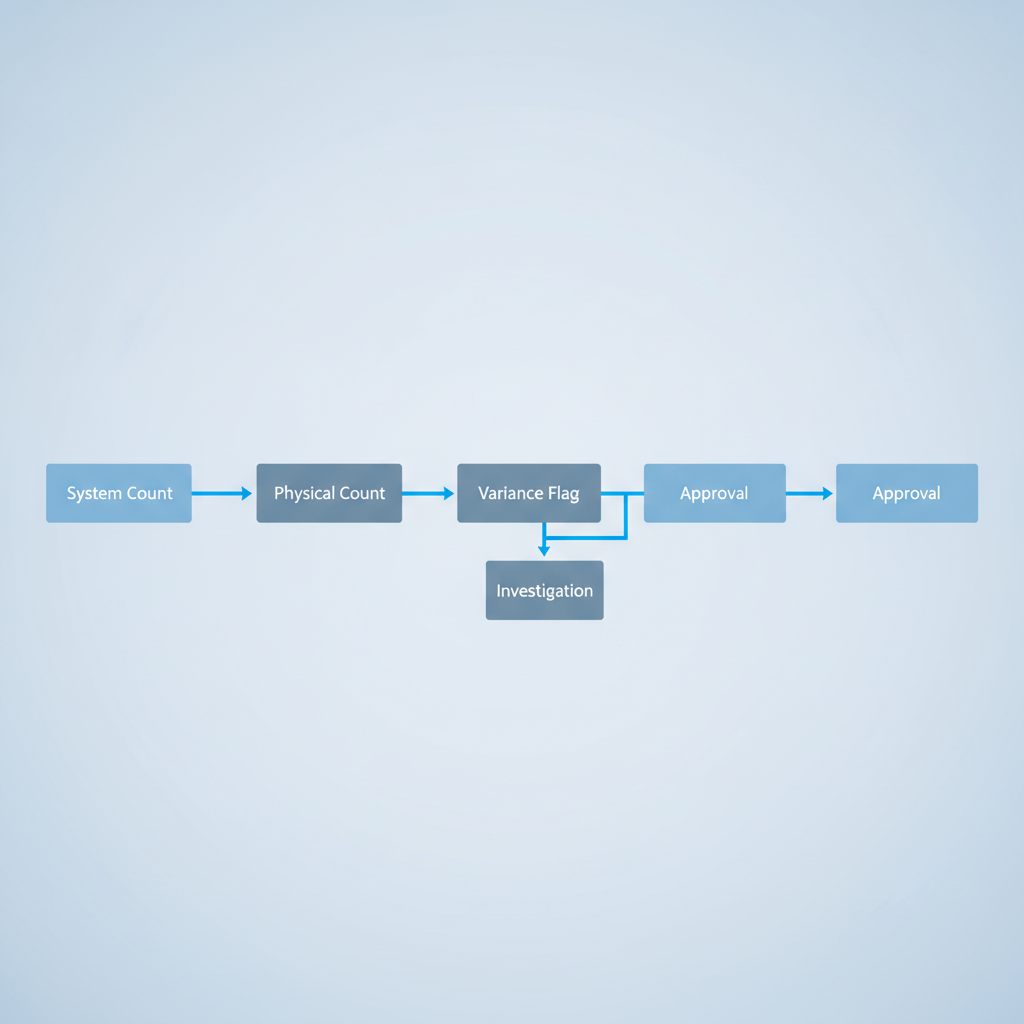
The five stages of a defensible reconciliation process
1. Pull the system snapshot
Start by locking a snapshot of on-hand quantities by SKU and location at a specific timestamp. This matters because inventory keeps moving: receiving, picking, and transfers don't pause for a count. Shipider's warehouse location records give you a snapshot that's tied to actual scan events rather than a manual export, so the starting number reflects real movement history, not a stale report.
2. Count the physical stock
This is the count itself, whether it's a full count or a rolling cycle count. If your team is still figuring out how to count without stopping the floor, our piece on cycle counting without shutting down the warehouse covers cadence and coverage. For reconciliation purposes, what matters is that the count is captured against the same location and SKU structure as the system snapshot, so the comparison in the next step is apples to apples.
3. Compare and flag variances
Line up the physical count against the system snapshot and flag every SKU where the numbers don't match, including small variances. Teams that only flag "significant" gaps miss the pattern of a SKU that's quietly off by two or three units every week, which usually points to a process issue rather than a one-off error. Every flagged line should carry the SKU, the location, the system quantity, the counted quantity, and who performed the count.
4. Investigate before you adjust
This is the step most spreadsheet-based processes skip. Before changing any number, check the movement history for that SKU and location: recent receipts, put-away location changes, transfers between sites, and dispatches. Common findings at this stage include a put-away logged to the wrong bin, a partial pallet split without an updated count, or a transfer between locations that wasn't confirmed on both ends. In Shipider, this history is attached to the pallet and SKU record automatically, so investigating a variance means reading a timeline, not asking around the floor.
5. Approve adjustments with maker-checker
Once the reason is understood (or documented as unexplained shrinkage), the adjustment gets proposed by one person and approved by a second before it posts to the system of record. That's the maker-checker step: it stops a single person from both finding a discrepancy and quietly correcting it with no oversight. For a full walkthrough of how that pattern works across receiving, picking, and adjustments, see what is a maker-checker workflow.
Building a cadence that doesn't drain your team
Reconciliation doesn't have to mean a full stock-take every month. Most warehouses do better with a layered cadence: high-value or fast-moving SKUs get reconciled weekly, mid-tier SKUs monthly, and slow movers quarterly. The trigger points that should always force an unscheduled reconciliation include a large unexplained order shortage, a new 3PL client's inbound stock, and the run-up to peak season, which we cover in the peak season prep checklist.
The point of a cadence is predictability. If reconciliation only happens when something goes visibly wrong, you're always investigating after the customer already noticed. A scheduled process catches drift while it's still small enough to explain.
Manual spreadsheet reconciliation vs a system-backed process
| Step | Spreadsheet-based reconciliation | Shipider reconciliation |
|---|---|---|
| System snapshot | Manual export, often hours or days stale | Live location and SKU record tied to scan events |
| Variance detection | Manual formula comparison, easy to miss small gaps | Flagged automatically at count entry |
| Investigation | Asking staff to recall what happened | Movement history attached to the pallet and SKU |
| Adjustment approval | Whoever found it can also fix it | Maker-checker: a second person approves every adjustment |
| Record of what happened | Overwritten cells, no history | Permanent audit trail: who, what, when |
| Multi-site or multi-client visibility | Separate files per site or customer | Structural isolation with a unified view for the operator |
What a reconciliation record should include
Whatever tool you use, a defensible reconciliation record needs six things: the SKU and location, the system quantity at the time of the snapshot, the counted quantity, the identified reason for the variance (or "unexplained"), who proposed the adjustment, and who approved it. If any one of those is missing, the record is a note, not proof. This is the same standard that matters when a damaged pallet or a shortage claim turns into a dispute with a customer or carrier, which is why the same evidence discipline shows up in our damaged pallet dispute workflow.
Common mistakes that keep the gap open
A few patterns show up repeatedly in warehouses that struggle with reconciliation. Adjusting inventory directly during picking, without routing it through a review step, is the most common one: it fixes the immediate order but erases the evidence of the pattern. Reconciling by SKU total across the whole warehouse instead of by SKU and location is another; a SKU can be accurate in aggregate while being wrong in three different bins, and that location-level error is exactly what causes the next mis-pick. Treating every variance as shrinkage without checking movement history is a third: a lot of what looks like loss is actually a mis-recorded transfer or a put-away to the wrong bin.
Finally, some teams reconcile the numbers but never close the loop with a second approver. That leaves the reconciled figure sitting at the same trust level as the original discrepancy: someone's word.
How Shipider supports the reconciliation process
Shipider ties reconciliation to the same records used for receiving, put-away, and dispatch, rather than treating it as a separate spreadsheet exercise. Counts are captured with in-browser camera barcode scanning on any phone, so there's no dedicated scanner to check out and return. Every SKU and pallet carries a movement history you can pull up during investigation instead of relying on memory. Adjustments route through a maker-checker step so a proposed change and its approval are two separate, logged actions. And because the audit trail covers every site, a 3PL running reconciliation across multiple customers under one roof still gets a clean, isolated record for each one. None of this requires new hardware or a long rollout; it runs on the same setup used for daily warehouse operations. For the broader picture of how traceability and accuracy fit together across receiving, storage, and dispatch, see the inventory accuracy and traceability hub, and if you're weighing whether a dedicated system is worth it versus staying on spreadsheets, our pricing page lays out the token-based model with no per-seat cost.
Frequently asked questions
What is the difference between a cycle count and inventory reconciliation?
A cycle count is the act of physically counting a subset of inventory on a rotating schedule. Reconciliation is the follow-up process of comparing that count to the system record, investigating any variance, and formally approving an adjustment before the number changes.
How often should a warehouse run inventory reconciliation?
A layered cadence works best: weekly for high-value or fast-moving SKUs, monthly for mid-tier items, and quarterly for slow movers, with additional reconciliation triggered before peak season or when onboarding new inbound stock.
Who should approve inventory adjustments during reconciliation?
A second person separate from whoever proposed the change, following a maker-checker pattern. This prevents the same individual from both finding a discrepancy and quietly correcting it without oversight.
What causes most inventory reconciliation variances?
Common causes include put-away to the wrong location, unconfirmed transfers between sites, partial pallets split without an updated count, and miskeyed quantities during receiving. Checking movement history before adjusting usually reveals which one applies.
Can inventory reconciliation be done without a WMS?
Yes, but it depends on manual spreadsheet comparisons and personal recall to investigate variances, which makes the process slower and harder to defend. A system that ties counts to scan events and keeps a permanent audit trail removes most of that manual overhead.
Ready to see a reconciliation process that actually holds up to scrutiny? Create a free Shipider account and run your next count with maker-checker approval and a full audit trail built in.
Related reading: Warehouse Shrinkage: Causes and How Evidence-Based Tracking Reduces Loss
Related reading: Lot and Batch Tracking for Perishable or Regulated Inventory