
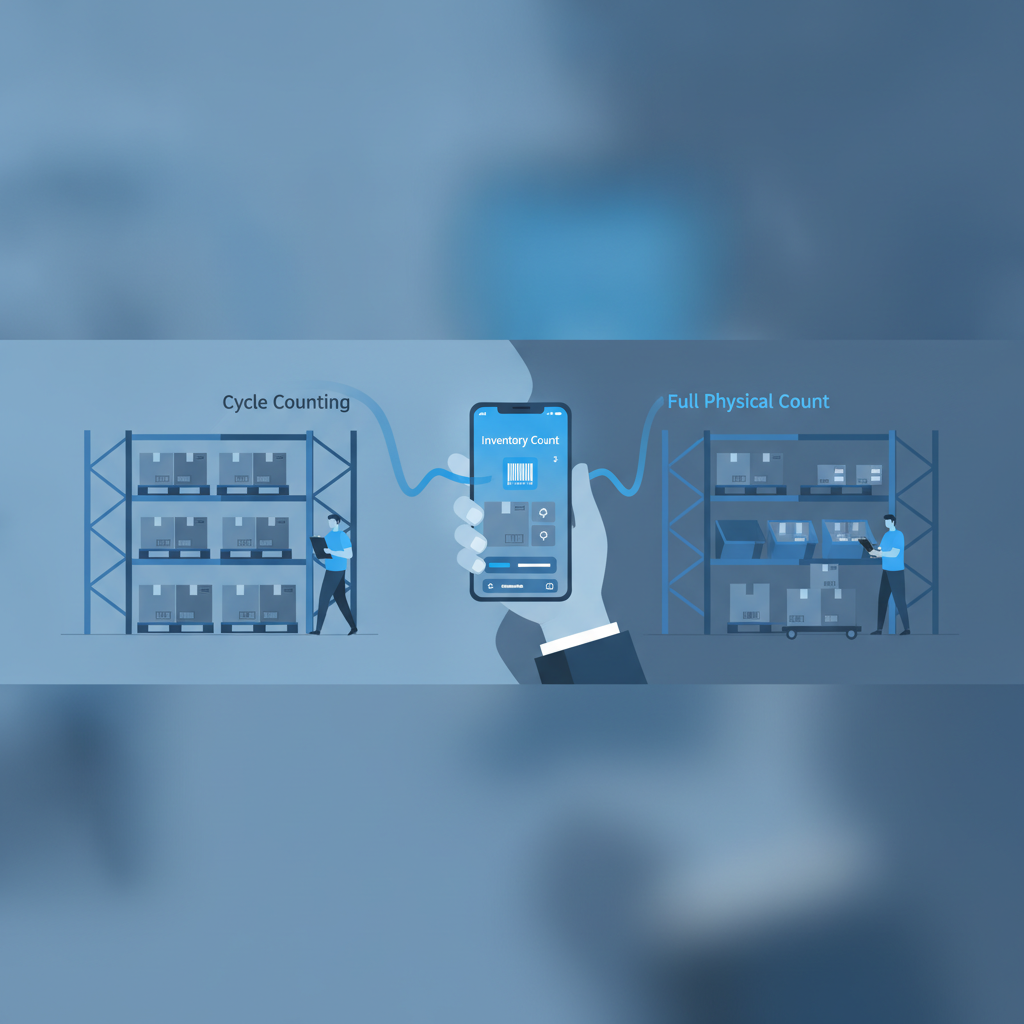
Cycle counting is the practice of counting a small, defined subset of inventory, such as one location, one SKU category, or one pallet run, on a repeating schedule instead of counting the entire warehouse at once. In Shipider, cycle counts are logged against specific warehouse locations and SKUs, with every count tied to a timestamp, a user, and a result, so discrepancies show up fast without anyone closing the floor.
The term gets used loosely in a lot of warehouse conversations, often interchangeably with a full physical inventory count. They are not the same thing, and mixing them up leads to the wrong tool for the wrong job. This article is a plain definition: what cycle counting means, how it actually runs on a warehouse floor, and where it stops being enough on its own.
The short definition
Cycle counting is a continuous inventory verification method where a portion of stock is counted on a rotating basis, usually daily or weekly, rather than counting every SKU in the building on one fixed date. The goal is to catch and correct discrepancies in small batches, throughout the year, so errors do not compound into a large year-end surprise.
Because only a slice of inventory is touched at a time, the rest of the warehouse keeps receiving, picking, and shipping normally. That is the core appeal: accuracy work happens in parallel with operations, not instead of them.
How a cycle count actually runs
A typical cycle count has four steps, whether it is done on paper, in a spreadsheet, or in a WMS.
1. Select the count group
A warehouse picks which locations or SKUs to count on a given day. This could be a single aisle, a specific pallet type, a list of top-moving SKUs, or anything flagged by a prior discrepancy.
2. Count without stopping other work
A counter walks the selected locations, scans or records what is physically there, and compares it against the system quantity. In Shipider this step uses the same in-browser barcode scanning that receiving and picking use, so no separate scanner hardware is needed and the count happens on a regular phone.
3. Flag and investigate variances
If the physical count does not match the system record, that location or SKU gets flagged. Someone looks for the obvious causes first: a miscount, a mis-putaway, a transaction that was never logged.
4. Adjust and log the reason
Once the real quantity is confirmed, the system of record is corrected and the reason for the variance is noted. This is where an audit trail matters: a correction with no record of who made it and why is just a new discrepancy waiting to happen later.
Because each of these steps touches a small slice of inventory, a warehouse can run count groups every day without ever needing to block picking, receiving, or shipping.
Cycle counting vs a full physical inventory count
A full physical count (sometimes called an annual count or wall-to-wall count) is the opposite approach: every SKU in every location gets counted, usually on one scheduled date, often requiring the warehouse to pause normal operations for part or all of a day.
| Factor | Cycle counting | Full physical count |
|---|---|---|
| Scope | Small, rotating subset of SKUs or locations | Entire inventory, every location |
| Frequency | Daily, weekly, or by rotation schedule | Typically once or twice a year |
| Operational impact | Warehouse keeps running during the count | Usually requires pausing picking and shipping |
| Staffing | One or two people, ongoing | Most or all available staff, concentrated effort |
| Error detection speed | Issues caught within days of occurring | Issues may go unnoticed for months |
| Best used for | Maintaining accuracy continuously | Financial audits, year-end reconciliation, system resets |
Neither method replaces the other entirely. Many warehouses run cycle counts year-round to keep day-to-day accuracy high, then run one full physical count annually to satisfy audit or accounting requirements. If your current process is a yearly scramble with no counting in between, read cycle counting without shutting down the warehouse for the practical steps to build a rolling schedule.
Why warehouses use cycle counting instead of waiting for the annual count
A full physical count tells you where inventory stood on one specific day. It does not tell you when or why a discrepancy happened, because three hundred and sixty days passed between counts. By the time the gap is found, the receiving error, the mis-pick, or the damaged pallet that caused it is long gone from anyone's memory.
Cycle counting narrows that window. If a location is counted every few weeks, a variance points back to a handful of transactions instead of a year's worth. That makes finding the root cause of a SKU discrepancy realistic instead of guesswork.
It also spreads labor out. A full count pulls staff off regular duties for a day or more. Cycle counting fits into existing shifts in small blocks of time, which is part of why it works for warehouses that cannot afford to shut down, including most small and mid-sized 3PLs and e-commerce fulfillment operations.
Common cycle counting methods
There is no single correct way to choose what gets counted. A few patterns show up most often:
- ABC analysis: high-velocity "A" SKUs get counted most frequently, slower "C" SKUs less often, since errors on fast movers cause the most downstream problems.
- Location-based rotation: the warehouse is divided into zones or aisles, and each zone gets counted on a fixed cycle regardless of what SKUs sit there.
- Random sampling: locations or SKUs are selected at random each cycle, which avoids bias toward easy areas and surfaces problems anywhere in the building.
- Control group counting: a small, fixed set of SKUs gets counted very frequently as a canary for process health; if those stay accurate, confidence extends to the rest of inventory.
Most warehouses blend these: ABC for day-to-day priority, with occasional random counts to catch anything the ABC logic might overlook.
How Shipider supports cycle counting on a live floor
Shipider treats cycle counting as a normal warehouse task rather than a special project. A few specific capabilities make the rotating-count approach practical:
- In-browser barcode scanning: any phone with a camera can scan a location or pallet during a count, so there is no separate scanner to check out or charge.
- Pallet and SKU tracking: counts can be scoped to a pallet, a SKU, or a full location, matching whichever cycle counting method a warehouse uses.
- Real audit trail: every count and every adjustment is logged with who performed it and when, which is what turns a one-off correction into usable data for root cause work later.
- Multi-site inventory: for operations running more than one location, cycle count schedules and results stay separated and comparable site by site.
- Maker-checker verification: larger adjustments can require a second person to confirm before the system of record changes, which keeps a single miscount from silently becoming the new truth.
None of this requires stopping the floor. A counter scans, the system compares, and the rest of the warehouse keeps moving.

When a full physical count is still the right call
Cycle counting is not a replacement for a full count in every situation. A full physical count still makes sense when:
- Accounting or an external audit requires a point-in-time inventory valuation.
- A warehouse is migrating off spreadsheets or a legacy system and needs a clean starting baseline.
- Cycle count variances have been high enough that confidence in the overall inventory record is in question.
- A location is being closed, merged, or transferred and every SKU needs to be reconciled before the move.
Outside of those cases, a well-run rotating cycle count schedule usually keeps accuracy higher year-round than waiting for one annual event. For the KPIs that tell you whether your cycle counting is actually working, see inventory accuracy KPIs every warehouse manager should track, and for the math behind the accuracy percentage itself, see the inventory accuracy formula guide.
Frequently asked questions
What is cycle counting in a warehouse?
Cycle counting is a method of verifying inventory accuracy by counting a small, defined subset of SKUs or locations on a repeating schedule, rather than counting the entire warehouse on one fixed date. It lets a warehouse catch and correct discrepancies continuously without pausing operations.
How is cycle counting different from a physical inventory count?
Cycle counting touches a small portion of inventory regularly, usually daily or weekly, and does not require stopping work. A full physical inventory count covers every SKU in every location, typically once or twice a year, and usually requires pausing picking and shipping for part of a day.
How often should a warehouse run cycle counts?
Frequency depends on SKU velocity and risk. High-moving or high-value SKUs are often counted weekly or more, while slow movers might be counted monthly or quarterly. Most warehouses use an ABC-based schedule so faster-moving inventory gets checked more often than slow stock.
Does cycle counting replace the need for an annual physical count?
Not always. Many businesses run cycle counts year-round for day-to-day accuracy and still perform one full physical count annually to satisfy accounting, audit, or financial reporting requirements. Cycle counting reduces surprises at that annual count; it does not automatically remove the need for one.
Can cycle counting be done without barcode scanners or special hardware?
Yes. Cycle counts can be performed with any phone that has a camera, using browser-based barcode scanning instead of dedicated scanner guns. Shipider runs this scanning directly in the browser, so counters do not need separate hardware to log a count.
Ready to see cycle counting run inside a real audit trail, with no scanner hardware and no shutdown? Start with Shipider and set up your first rotating count schedule today.
Related reading: What Is Pallet-Level Traceability? A Definition for Evidence-Based Warehouses
Related reading: ABC Analysis for Warehouse Inventory: Prioritizing What You Count Most Often