
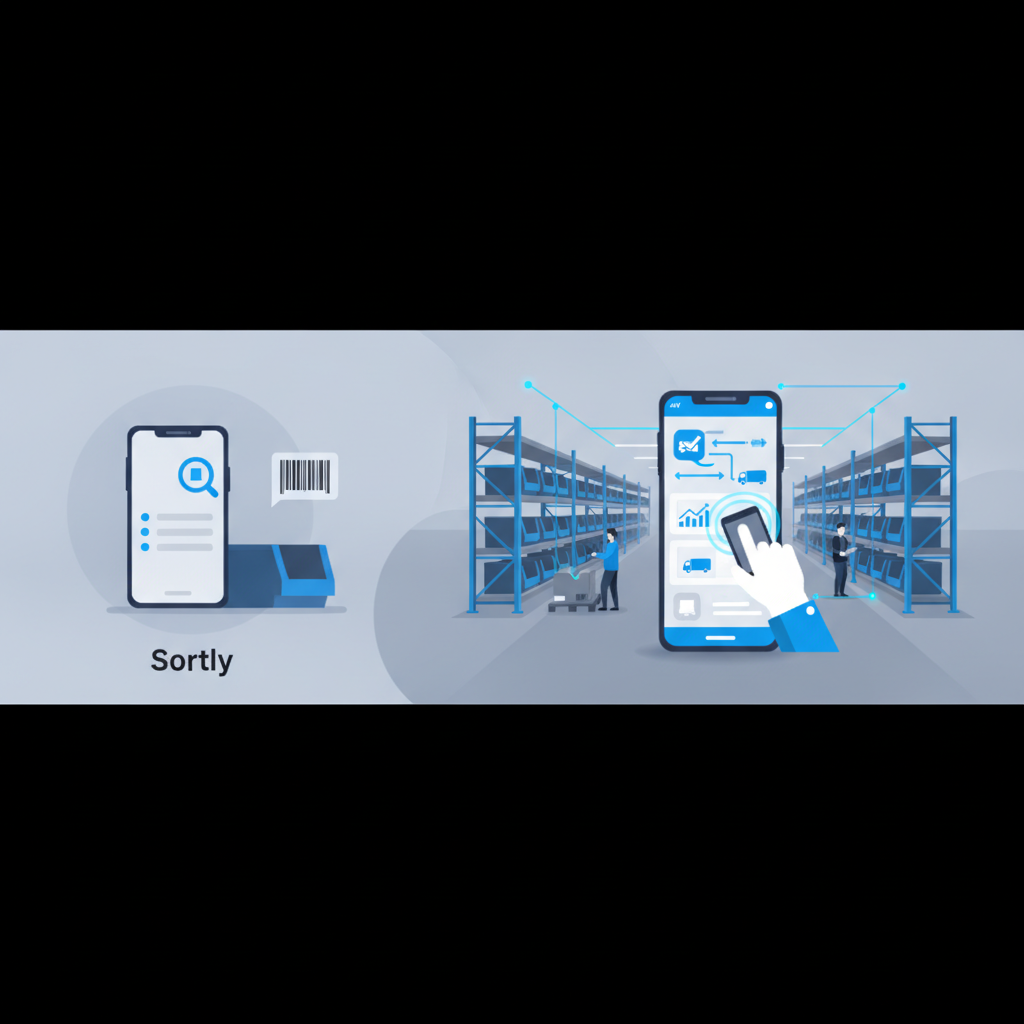
Shipider is a multi-tenant warehouse management platform built for receiving, putaway, pallet and SKU tracking, order verification, and dispatch, while Sortly is an inventory and asset tracking app built for tagging items, organizing them into folders, and counting what you have. The two solve different problems: Sortly answers "what do I own and where is it," Shipider answers that question plus "who moved it, who verified it, and did the right pallet leave the building." If your operation has grown past simple item counts into real warehouse workflows, the gap between the two becomes the whole story.
What Sortly actually does well
Sortly earned its place with small teams because it is easy to set up. You create folders, tag items with QR codes or barcodes, snap a photo, and track quantity across a few locations. For a studio, a small retail backroom, or a team tracking equipment and supplies rather than running order fulfillment, that is often enough. It is not trying to be a warehouse management system, and for the audience it targets, that is fine.
The trouble starts when a business that picked Sortly for simple item counting starts acting like a warehouse: taking in pallets from vendors, assigning bin locations, picking and packing customer orders, and shipping to multiple destinations. Sortly was never built for that sequence, and stretching it to cover receiving-to-dispatch workflows means bolting spreadsheets, group chats, and manual double-checks onto a tool that has no concept of any of it.
Where Sortly runs out of road
Three gaps show up most often when a growing operation outgrows Sortly:
- No warehouse location model. Sortly tracks items in folders, not in a structured warehouse map of zones, aisles, and bins. There is no putaway workflow that tells a worker exactly where a pallet should land, and no way to see what is sitting in location B-12-3 right now.
- No verification step. Sortly has no built-in second check before an order ships or a pallet moves. One person updates a count and that is the record. There is nothing structurally stopping a wrong-item pick from going out the door.
- No tenant separation for multiple clients. If you run a 3PL or manage inventory for more than one brand or customer under one roof, Sortly has no architecture to keep Customer A's stock, users, and reporting cleanly isolated from Customer B's. [NEEDS VERIFICATION: confirm current Sortly plan tiers do not include a multi-tenant or client-isolation feature]
None of this makes Sortly a bad product. It just means it was built to answer a narrower question than the one a growing warehouse needs answered.

Shipider vs Sortly: feature by feature
| Capability | Sortly | Shipider |
|---|---|---|
| Item and quantity tracking | Yes, folder-based | Yes, SKU and pallet level with location detail |
| Barcode/QR scanning | Yes, via phone camera | Yes, in-browser camera scanning on any phone, no app install or dedicated hardware |
| Warehouse locations (zones, aisles, bins) | No structured location model | Yes, full receiving-to-putaway location tracking |
| Pallet-level tracking | No | Yes, with photos and movement history |
| Maker-checker (two-step) verification | No | Yes, on receiving, picking, and dispatch |
| Audit trail of who did what and when | Basic activity log | Full audit trail tied to every scan and verification |
| Multi-site inventory | Limited, no workflow depth across sites | Yes, built for multiple warehouse locations |
| Multi-tenant client isolation (for 3PLs) | No | Yes, structural isolation per customer |
| Order processing workflow | Not a core function | Yes, from order to verified pick to dispatch |
| Pricing model | Per-user subscription tiers [NEEDS VERIFICATION: confirm current Sortly pricing structure] | Token-based, usage-driven pricing |
| Setup time | Fast, minutes | Fast, no hardware required, typically live within days not months |
Multi-tenancy: the structural difference
If you are a 3PL, or an operator managing fulfillment for several brands from one building, multi-tenancy is not a nice-to-have feature, it is the entire architecture question. Sortly was designed around a single organization tracking its own items. Shipider was designed with the assumption that one warehouse might hold inventory for five, ten, or thirty separate customers, each needing their own visibility, their own users, and their own reporting without seeing anyone else's stock.
That isolation runs through the data model itself, not through a workaround like duplicate accounts or shared spreadsheets split by tab. If you are evaluating software specifically because you are onboarding a new warehousing client, this is worth reading alongside how to onboard a new 3PL client without adding headcount, and the 3PL solutions page for how the isolation model works in practice.
Maker-checker: the verification Sortly doesn't have
A maker-checker workflow means one person performs an action (a pick, a receipt, a dispatch) and a second person or scan step confirms it before it counts as done. Sortly has no equivalent. A quantity update is just a quantity update, made by whoever is logged in, with no structural pause for a second set of eyes.
In a warehouse processing dozens or hundreds of orders a day, that gap is where mis-ships come from: a picker grabs the adjacent SKU, nobody catches it, and the wrong item ships. Shipider's maker-checker step sits inside the scanning workflow itself, so the second verification happens as part of the normal process rather than as an extra task someone has to remember to do. For the mechanics of why this matters operationally, see how to reduce mis-ships with a better packing workflow and what a maker-checker workflow actually is.
Pallet tracking and the audit trail Sortly can't produce
Item-level tracking tells you what you have. Pallet-level tracking tells you what arrived, in what condition, signed off by whom, and where it has moved since. Sortly's photo-and-count model stops at the item. Shipider attaches photos, signatures, and a full movement history to each pallet, which matters most the moment a customer disputes a shortage or a damaged shipment. A tracker with no audit trail leaves you arguing from memory; a system with a real trail lets you point to the record.
Migrating from Sortly without a stalled project
Moving off any inventory tool feels riskier than staying put, mostly because nobody wants a multi-month rollout. Shipider is built around the opposite expectation: no hardware to procure, no six-month implementation, and item data that can move over through a standard import rather than manual re-entry. The practical sequence looks like this:
- Export your current item list and locations from Sortly.
- Import SKUs into Shipider and map them to real warehouse locations (zones, aisles, bins) rather than flat folders.
- Run receiving and putaway for a few days in parallel with your old process to confirm counts match.
- Turn on maker-checker for picking and dispatch before fully cutting over, so verification is live from day one.
If you want the fuller switching narrative with more migration detail, the companion piece Sortly alternative for warehouses that need multi-tenant and maker-checker covers that path step by step. For a wider look at how to evaluate any system against your current one, the WMS alternatives and comparisons hub lays out a general framework.
Who should actually stay on Sortly
Not every team needs to switch. If you are tracking office equipment, construction tools, a small studio's supplies, or asset counts with no receiving-to-dispatch order flow and no second-party verification requirement, Sortly's simplicity is a feature, not a limitation. The decision point is whether your daily work includes putaway to specific locations, picking against real customer orders, or managing inventory for more than one business under your roof. If any of those are true, an inventory-only tracker will keep costing you in manual workarounds no matter how cheap the subscription looks.
Brands running DTC fulfillment specifically should also compare against the dedicated workflow built for that model on the e-commerce solutions page, since order verification and multi-site stock matter differently for retail fulfillment than for asset tracking.
Frequently asked questions
Is Sortly a warehouse management system?
No. Sortly is an inventory and asset tracking app built for counting and organizing items in folders with photos and barcode or QR tags. It does not include a structured warehouse location model, a receiving-to-dispatch order workflow, or a verification step before inventory moves, which are core functions of a WMS like Shipider.
Does Sortly support multi-tenant inventory for multiple clients?
Sortly was designed for a single organization tracking its own items and does not provide structural isolation between separate customers' inventory, users, and reporting. 3PLs managing multiple clients from one warehouse need a platform built with multi-tenant isolation from the ground up. [NEEDS VERIFICATION: confirm no Sortly plan currently markets a multi-tenant or client-separation feature]
What is maker-checker verification and why does Sortly not have it?
Maker-checker is a two-step workflow where one action, like a pick or a receipt, is confirmed by a second scan or a second person before it is recorded as final. Sortly records whatever the logged-in user enters with no required second confirmation, while Shipider builds this verification step directly into receiving, picking, and dispatch.
Can I migrate my item list from Sortly to Shipider?
Yes. Items and quantities can be exported from Sortly and imported into Shipider, then mapped to real warehouse locations such as zones, aisles, and bins instead of flat folders, which sets up the receiving and putaway workflow that Sortly does not have.
Does Shipider require barcode scanner hardware like Sortly does not?
Neither platform requires dedicated scanner hardware. Shipider runs camera-based barcode scanning directly in the browser on any phone, the same way Sortly's mobile scanning works, but Shipider extends that scanning into full receiving, putaway, pick verification, and dispatch steps rather than stopping at an item count.
If your warehouse has outgrown folders and item counts, see what a system built for receiving, verification, and multi-site stock looks like. Start free with Shipider and bring your item list over in an afternoon.
Related reading: What Is a WMS? A Plain-Language Definition for Teams Leaving Excel
Related reading: Building an ROI Business Case for a WMS: What to Show Your Leadership