
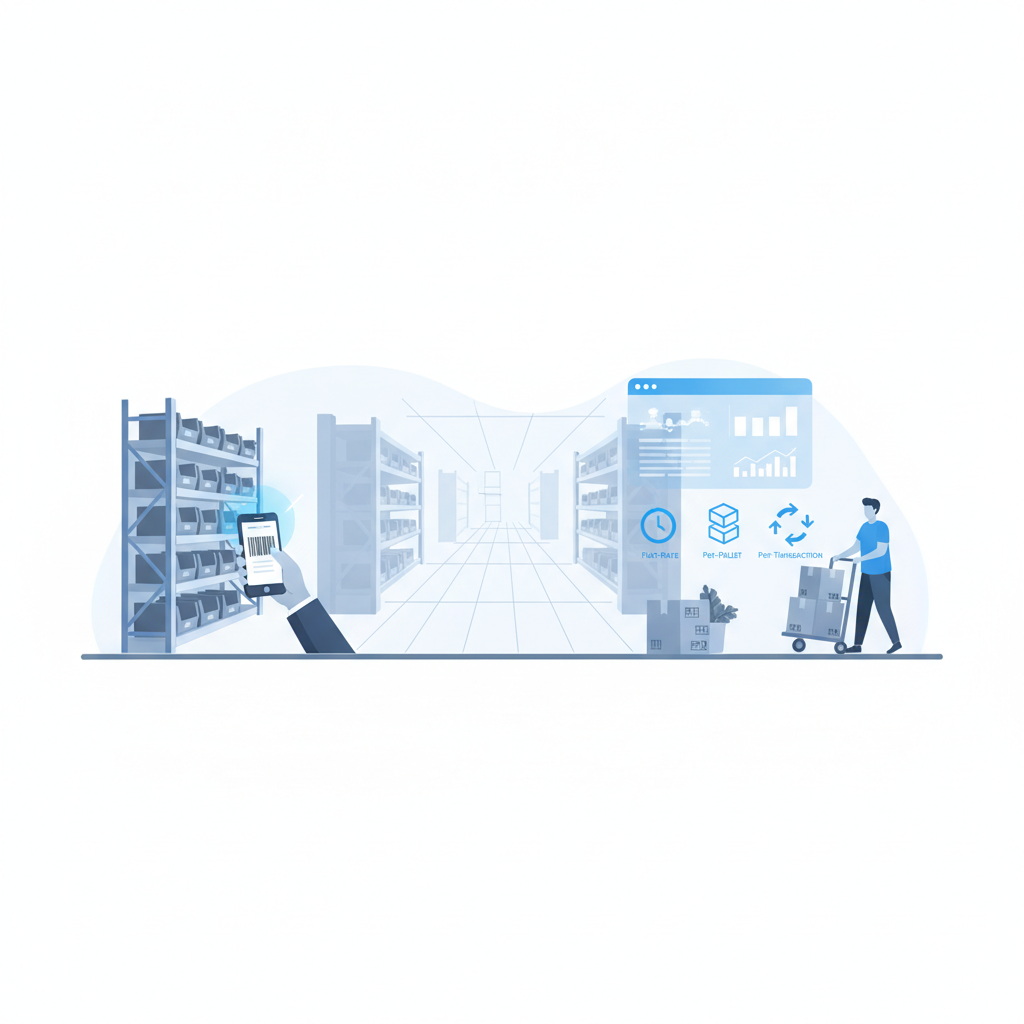
3PL per-customer invoicing models are the pricing structures a third-party logistics provider uses to bill each client separately for storage and handling, and they generally fall into three buckets: flat-rate (a fixed monthly fee regardless of volume), per-pallet (billed on stored or handled pallet count), and per-transaction (billed per receiving line, pick, or order touched). Shipider supports multi-tenant 3PL operations with structural client isolation, pallet and SKU tracking, and a real audit trail, which gives you the underlying activity data any of these three models depend on, even though the invoicing math itself usually lives in your accounting or billing tool.
Why the billing model matters more than it looks
Most 3PLs do not choose an invoicing model once and move on. They end up running two or three models at the same time because clients arrive with different shapes of business. A slow-moving B2B distributor with six pallets of stable SKUs looks nothing like a DTC brand shipping two hundred single-unit orders a day. Billing both the same way either overcharges one or underpays for the other, and either mistake shows up fast: in margin, or in a client who leaves over a surprise invoice.
The deeper problem is that billing disputes are almost never about the rate. They are about whether the activity actually happened the way the invoice says it did. A client who gets billed for 40 pallets stored when they think they have 34 will ask for proof before they pay, and if your warehouse software cannot show location history, movement timestamps, and who touched what, you are negotiating from a weak position. That is the real reason billing models and operational traceability are tied together: the invoice is only as defensible as the data behind it.
The three core invoicing models
Flat-rate billing
Flat-rate billing charges a client a fixed fee per month (or per period) regardless of how much volume they actually move. It is simple to quote, simple to invoice, and easy for a client to budget around. It works best for stable accounts with predictable, low-variance volume, think a wholesale client who ships roughly the same number of pallets every month.
The risk is obvious: if volume spikes, you absorb the extra labor and space cost unless the contract has a cap or an overage clause. Flat-rate contracts that survive long term almost always include a stated volume ceiling (for example, up to 50 pallets or 500 order lines per month) with a defined overage rate above that. Without the ceiling, flat-rate billing quietly turns into a loss leader during peak season.
Per-pallet billing
Per-pallet billing charges based on pallets stored, pallets received, or both, often with separate rates for storage (a recurring per-pallet-per-month fee) and handling (a one-time fee per pallet in or out). This is the standard model for bulk, low-SKU-velocity clients where pallet count is a fair proxy for space and labor consumed.
Per-pallet billing is easy to defend when your system tracks pallets at the location level, not just at the SKU level. If a client questions a storage charge, you want to be able to show exactly which pallet sat in which location for how long, not just a total count pulled from memory or a spreadsheet. This is where pallet-level traceability stops being a nice-to-have and becomes the thing that keeps an invoice from turning into a dispute.
Per-transaction billing
Per-transaction billing charges per discrete activity: per receiving line, per pick, per pack, per order shipped. It is the natural fit for high-velocity, low-pallet-count clients, particularly DTC and e-commerce brands where the real cost driver is labor touches, not storage space. A client shipping thousands of single-unit orders a month generates almost no storage cost but a lot of pick-and-pack labor, and per-transaction billing captures that correctly where per-pallet billing would undercharge it badly.
The tradeoff is invoice complexity. Per-transaction billing produces long line-item invoices, and clients will want to reconcile them against their own order counts. That reconciliation only goes smoothly if every transaction (receiving, putaway, pick, pack, dispatch) is logged with a timestamp and tied to a specific order or SKU, which is exactly what an order-processing workflow with maker-checker verification produces as a side effect of normal operations, not as a separate billing exercise.

Comparing the three models
| Model | Best fit | Billing complexity | Main dispute risk | Data you need to defend it |
|---|---|---|---|---|
| Flat-rate | Stable, predictable volume clients | Low | Volume creeping past what the flat fee covers | Monthly pallet and order counts vs. the contracted ceiling |
| Per-pallet | Bulk, low-SKU-velocity, B2B/wholesale | Medium | Disagreement over pallet count or dwell time | Location history per pallet, received and shipped dates |
| Per-transaction | High-velocity, low-pallet, DTC/e-commerce | High | Client reconciling line items against their own order system | Timestamped record of every receiving line, pick, and pack |
Hybrid models are the norm, not the exception
In practice, most 3PLs running a mixed client base end up with hybrid contracts: a base flat storage fee plus per-transaction handling charges, or per-pallet storage plus per-order pick fees. This is not a sign of a messy pricing strategy, it is usually the correct answer once you have clients with genuinely different operating profiles under one roof. The structural isolation that a multi-tenant 3PL warehouse needs, separate inventory, separate order queues, separate reporting per client, is also what makes hybrid billing workable, because each client's activity has to be tracked and attributable on its own, not blended into one warehouse-wide number.
[NEEDS VERIFICATION: whether Shipider's roadmap includes a dedicated per-client billing or rate-card module versus exporting activity data to an external billing or accounting system] is the kind of detail worth confirming with your account team before you commit to a billing workflow that assumes a specific export format or automation level.
The data every model actually needs
Regardless of which model, or combination, a 3PL chooses, accurate invoicing depends on the same underlying records:
- Which client owns which inventory, down to the SKU and pallet, with no cross-contamination between tenants
- When a pallet or SKU entered a warehouse location and when it left it
- Who performed each receiving, putaway, pick, pack, or dispatch action, and when
- A count that reconciles against what is physically on the floor, not just what the system assumes
This is the practical argument for running per-customer billing on top of a WMS with a real audit trail rather than reconstructing activity from memory or disconnected spreadsheets at month end. When a client disputes a line item, the fastest resolution is pulling the actual movement history for that pallet or order, not re-explaining your pricing logic.
How multi-tenant structure keeps invoicing clean
Multi-tenant isolation is often discussed as a security or data-privacy feature, but it has a direct billing consequence too. If inventory and orders are not cleanly separated by client, any usage-based billing model becomes guesswork, because you cannot be certain which transactions belong to which account. Warehouse software built for 3PLs from the ground up, like Shipider, keeps each client's inventory, locations, and order history structurally separate, which means the activity counts feeding your invoice are counts for that client specifically, not estimates pulled from a shared pool.
Camera-based barcode scanning that runs in the browser also matters here in a less obvious way: every scan, whether it is a receiving line, a putaway, or a pick, gets logged with a timestamp and a user, which is the raw material for per-transaction billing without anyone needing to manually log activity for billing purposes separately from the operational work.
Common mistakes 3PLs make with per-customer billing
The most frequent mistake is picking one model for every client because it is easier to administer, then discounting informally when it clearly does not fit. That erodes margin quietly and makes contract renewals awkward, because the client has gotten used to an unofficial discount with no paper trail explaining why.
The second mistake is under-specifying the contract itself: no stated pallet cap on a flat-rate deal, no clear definition of what counts as a transaction in a per-transaction deal, no agreed dwell-time rule for per-pallet storage (does a pallet get billed from the day it arrives or the day it gets put away). These gaps surface during disputes, not during the sales conversation, which is the worst possible time to discover them.
The third is relying on manual counts at month end instead of continuous tracking. A once-a-month manual pallet count is slow, error-prone, and gives the client no way to verify the number themselves. Continuous, system-recorded activity (the kind produced by scanning every receiving line and every pick as it happens) removes that friction entirely and tends to cut disputes, because the client can see the same record you are billing from.
If you are evaluating how to structure this for a new client relationship, onboarding a new 3PL client without adding headcount is a closely related decision: the billing model you pick during onboarding determines how much manual reconciliation work your team carries every month afterward.
Frequently asked questions
What is the most common invoicing model for small 3PLs?
Per-pallet billing is the most common starting point for small 3PLs, mainly because it is easy to explain to new clients and maps directly to physical space used. Many 3PLs add per-transaction handling fees on top once they take on higher-velocity e-commerce clients.
Can a 3PL use different billing models for different clients in the same warehouse?
Yes, and most 3PLs with a mixed client base do exactly this. A bulk wholesale client might be billed per-pallet while a DTC client on the same floor is billed per-transaction, as long as the warehouse software keeps each client's inventory and activity structurally separate so the two billing streams never overlap or miscount.
How do 3PLs avoid billing disputes over pallet counts?
The most reliable way is to track pallets at the location level with timestamps for when each pallet was received, put away, and shipped, so any disputed line item can be answered with an actual movement record rather than a verbal recollection of what was on the floor.
Is flat-rate or usage-based billing better for a 3PL?
Neither is universally better. Flat-rate billing suits stable, predictable accounts and is easier to administer, while usage-based billing (per-pallet or per-transaction) scales more fairly with volume swings but requires more detailed activity tracking to invoice accurately and defend disputes.
What data should a 3PL keep to support per-customer invoicing?
At minimum: which inventory belongs to which client, when pallets entered and left specific locations, and a timestamped, user-attributed record of every receiving, pick, pack, and dispatch action. This is the same operational data a multi-tenant WMS with an audit trail already produces during normal warehouse work.
If you are weighing which invoicing model fits your client mix, start with the operational data, not the spreadsheet. See how Shipider's multi-tenant structure, pallet tracking, and audit trail support defensible per-customer billing by exploring Shipider for 3PLs, check pricing, or create a free account to see it on your own floor.